Adjacent literature review
Find cross-disciplinary research by translating domain-specific jargon into shared underlying mechanisms. Use this skill during literature reviews, theory building, or paper positioning when searching within a single field yields redundant results or misses relevant work from other disciplines.
The problem it solves
Finds papers outside your field by translating your concepts into other disciplines' vocabulary.
- Dan
- Quentin
- Maren
- Tamara
Adjacent Literature Review
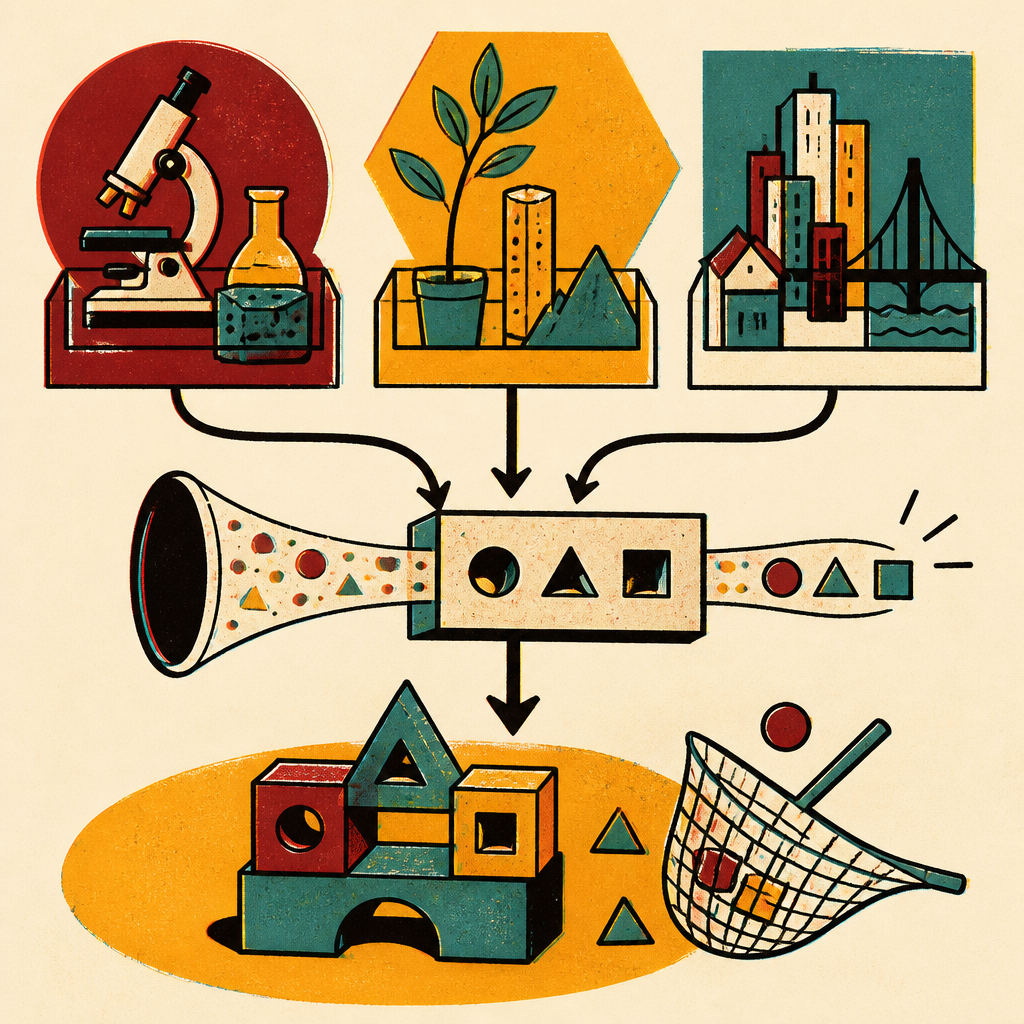
Finds work in neighbouring fields that studies the same mechanism under a different name. Default search fails at this because search terms are field-specific, so searching in your own vocabulary returns your own tradition. The work is translation, not retrieval.
Workflow
- Strip the construct to a mechanism. Restate the topic with every field-specific term removed, as a claim about how something works. "Absorptive capacity determines which external knowledge a firm can use" becomes "prior related knowledge determines what new information an agent can absorb." The de-jargoned version is what other fields will have a word for.
- Name 3 to 5 candidate fields, each with the shared mechanism that makes it plausible. If you can't articulate the mechanism, drop the field.
- STOP. Present the candidate fields and confirm which ones are worth pursuing before searching. Wait for the user's answer.
- Translate the vocabulary. Find each confirmed field's own term for the mechanism. If you don't know it, read a recent review or handbook chapter in that field and harvest terms. Get this wrong and every downstream search fails.
- Search each field in its own terms. Separate searches per field. Reviews and meta-analyses first, then key empirical work.
- Work the citation graph. Papers cited by both literatures are existing bridges. Also check for papers in the target field citing the user's field.
- STOP. Present the map (format A below) and let the user choose which threads to pull. No deep reading before this point. Do not write a lit-review section unless asked.
- For the chosen threads only, read properly and produce format B. Vet anything the user wants to import using the section below.
Vetting before importing
Does it still hold? Search "[construct]" replication and "[construct]" meta-analysis.
Several heavily borrowed psychology findings did not survive replication (ego depletion,
social priming, power posing) and others stay contested (stereotype threat, growth
mindset). Prefer bias-corrected meta-analyses over a single famous study, however well
cited.
Is it current? A paper can be canonical in your field and superseded in its own. Check recent reviews, not citation counts.
Has the bridge been built already? If someone in the user's field imported this construct before, they need to cite it, and the open question shifts to what that import missed.
Flag borrowed constructs that would be decorative, cited for authority but doing no work in the argument.
Output format
Format A: the map (step 7)
Built from abstracts, reviews and titles. ALWAYS use this exact template:
# Adjacent literature: [topic]

## Mechanism
[the de-jargoned restatement used for translation]

## [Field]
**Their term:**
**Why it's relevant:** [shared mechanism, 1-2 sentences]
**Candidate work:** [3-5 items, review or meta-analysis first]
**Health:** [replicated / contested / superseded / unknown]
**Already borrowed by your field?** [citation, or "no, this looks open"]

## Considered and rejected
[fields checked that didn't pan out, with reasons]

## Suggested next threads
Always include "Considered and rejected." A search that found nothing in a plausible place is a real result, and without it the user reruns it next month.
Format B: the read (step 8)
Only for threads the user selected. ALWAYS use this exact template:
# [Field]
**Their term:** [the field's name for the mechanism]
**Why it's relevant:** [1-2 sentences]

## [Author, year: title]
### Design
### Main results
### Related papers
### Citations [count, source, date checked]
### Health [replicated / contested / superseded / unknown]
Repeat the paper block for each paper in the field. Citation counts must come from a lookup, not from memory, and carry the source and date. Say so when a judgement rests on an abstract alone.
Edge cases
- False friends. The adjacent field may use the same word for something else. "Exploration" in reinforcement learning is formalised very differently from March's usage. Flag these; they cause bad citations.
- No results from a vocabulary search. Don't conclude the literature is absent. Route through a review article in that field, harvest terms, search again.
- Superficial analogy. If the shared mechanism is really a shared metaphor, drop the field. A thin cross-disciplinary citation is worse than none.
- User can't state the mechanism yet. Help them state it first. Everything after step 1 depends on it.
Tools
Use web_search and web_fetch for Google Scholar, Semantic Scholar, OpenAlex and
Connected Papers. Don't script API calls from bash, since the sandbox network allowlist
doesn't cover academic APIs.